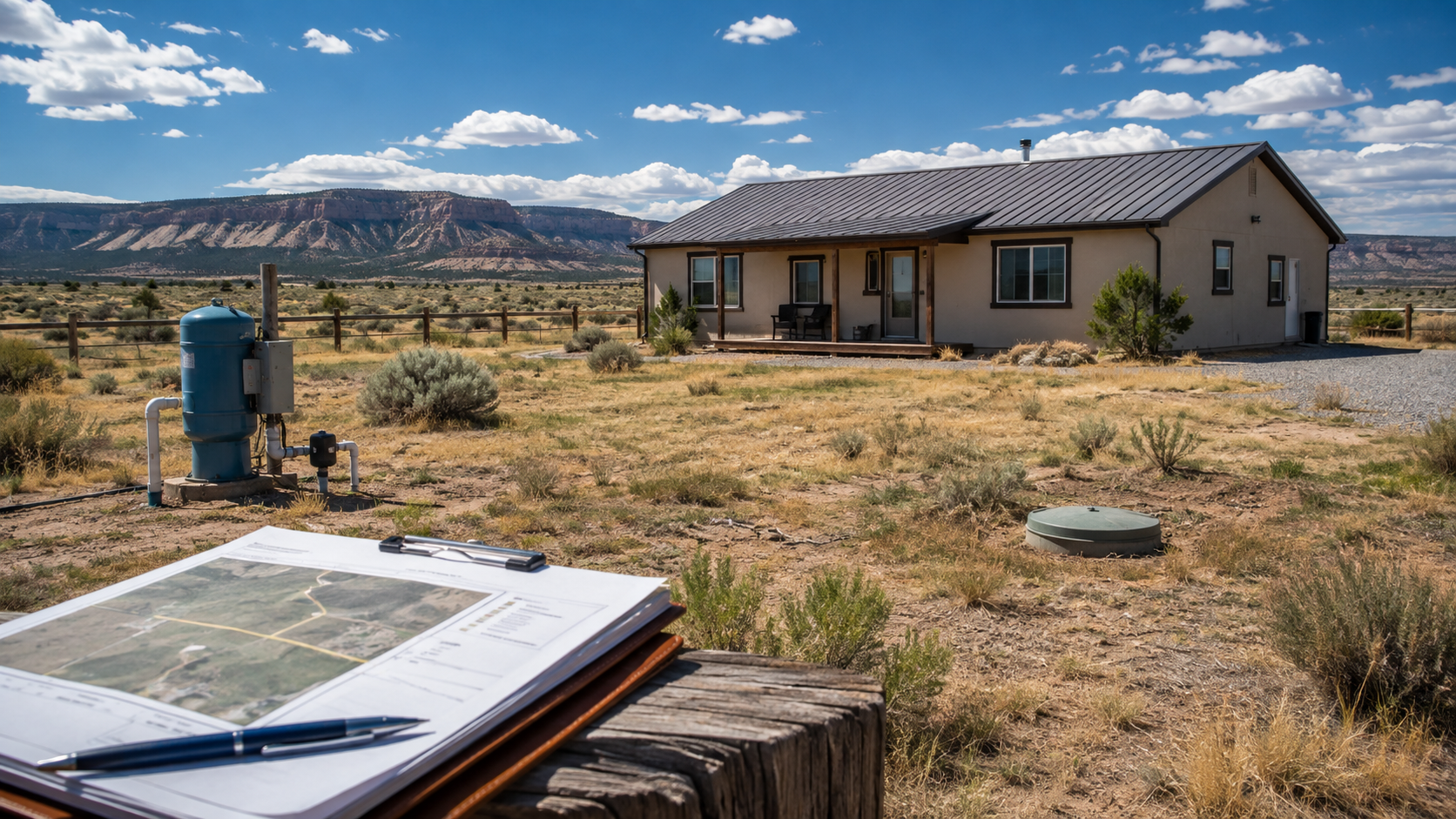
There is a certain kind of freedom that comes with a place on the edge of town. Room for horses in Flora Vista. A shop and some acreage outside Aztec. Quiet mornings on a mesa above Bloomfield with no neighbor in sight. Rural property is one of the best parts of living in San Juan County, and for many buyers it is the whole reason they are looking here in the first place.
It also comes with a set of questions a city lot never raises. Where does the water come from, and do you actually have the right to use it? How is wastewater handled, and is the system permitted and healthy? These are not small details. In New Mexico they can affect what a property is worth, whether you can build or expand, and in some cases whether you have any legal water at all. The good news is that all of it is knowable before you close, as long as you know where to look.
Here is what matters most.
The well: your water source, and the rules around it
Most rural homes in San Juan County draw from a private well rather than a municipal line. In New Mexico, groundwater is a public resource. The state owns it, and the Office of the State Engineer regulates who may pump it, how much, and for what use. That surprises buyers who assume the well in the yard simply belongs to the house. The physical well may convey with the property, but the right to use the water is a separate matter governed by state permit.
For a single household, the central approval is a domestic well permit issued under statute 72-12-1.1. It authorizes a limited annual amount of groundwater for household use, and it does not allow commercial uses such as water bottling, a car wash, or irrigating crops grown for sale. The exact amount and any local conditions depend on the groundwater basin, so the number attached to one permit will not always match another.
A few things are worth confirming on any property with an existing well:
- The well has a record on file. Legal wells are permitted, and licensed drillers file a well log with the State Engineer. The OSE keeps online records of well permits, well reports, and driller licenses. A well with no record is a red flag worth running down.
- The permit matches the use. A domestic permit covers a home. If a listing advertises irrigation, livestock at scale, or a commercial use, that may call for a different or additional water right.
- The well is shared, or it is not. Some rural parcels rely on a shared well serving more than one household. If so, there should be a written well share agreement spelling out cost, maintenance, and access. Ask for it early.
- The water performs. Beyond the paperwork, a well should be tested for both flow rate and water quality. A pretty house on a weak or contaminated well is an expensive problem to inherit.
Drilling a new well is possible, but it is not a weekend project. New wells generally require a permit from the State Engineer before any drilling begins, the work must be done by a licensed driller, and wells must meet siting rules, including minimum setbacks from other owners’ wells. Plan for time and cost if the property does not already have a working, permitted well.
The septic system: permitted, sized, and healthy
Outside city sewer service, homes rely on an on-site liquid waste system, which most people simply call septic. In every county but Bernalillo, these systems are permitted and regulated by the New Mexico Environment Department. That includes all of San Juan County. NMED issues the permit to install, inspects the work, and then issues the Permit to Operate.
When you are buying a home that already has septic, the questions are straightforward but important:
- Is there a permit on record? NMED maintains a searchable database of existing liquid waste permits. A permitted, inspected system is a very different thing from one someone installed without approval.
- Is it sized for the house? Systems are sized to the home, and bedroom count drives that calculation. A three-bedroom system serving a home that was later expanded to five bedrooms is undersized, and that becomes your issue after closing.
- What condition is the tank and drainfield in? Tanks should be watertight, and tanks installed after 1976 are required to have a baffle. The drainfield depends on suitable soils, which are confirmed by a soil or percolation test. A failing drainfield is one of the more costly repairs in rural real estate.
- Was any modification permitted? Replacing a system, changing the disposal method, or increasing the design flow all require a permit. Unpermitted changes can complicate a sale.
If you are planning to add on to a home, put in a casita, or otherwise increase the load on the system, understand that this may trigger a new permit and a system upgrade. It is far better to learn that during your inspection period than after you own it.
One more point buyers often miss: the well and the septic drainfield have to sit a required distance apart, and both have setbacks from property lines and structures. On smaller parcels those setbacks can limit where a new system or a replacement can go. It is worth confirming there is room to work.
Water rights: the part that trips people up
This is where New Mexico is genuinely different from most states, and where buyers get into trouble.
New Mexico follows the doctrine of prior appropriation, often summarized as “first in time, first in right.” The state owns all surface and groundwater, and the right to use that water is a property right that is separate from the land itself. Owning the dirt does not automatically mean you own a water right beneath or beside it. Those rights have to be verified, and in some cases purchased or permitted, on their own.
Water rights in New Mexico are treated as real property, which has a practical consequence at closing. If a property is sold with water rights, the deed should expressly state that the wells and water rights are included in the transfer. When ownership of a water right changes, a Change of Ownership form should be recorded with the Office of the State Engineer, and the documentation is commonly recorded with the county clerk as well, since these are real property interests.
For most homes on a straightforward domestic well, this is manageable. The complexity climbs on parcels that carry irrigation or agricultural water rights, and those are common along the river valleys near Bloomfield and across the San Juan Basin. A couple of things to keep in mind there:
- The San Juan River basin is being adjudicated. Adjudication is the long legal process of formally defining who holds which rights. It affects how rights are documented and transferred, and it is a reason to lean on people who work in these waters regularly.
- Diverted amount and transferable amount are not the same. For irrigation rights, only the “consumptive use” portion can typically be transferred, and that is often meaningfully less than the amount a property historically pumped or diverted. A listing that describes water in terms of what the ditch or pump delivered can overstate what actually conveys.
None of this should scare a buyer away from rural property. It should simply move water rights to the top of the due diligence list rather than treating them as an afterthought.
A simple due diligence checklist
Before you write an offer, and during your inspection period, work through this:
- Confirm the well is permitted and pull its record from the State Engineer.
- Verify the domestic permit matches the intended use, and get any well share agreement in writing.
- Test the well for flow and water quality.
- Confirm the septic system is permitted with NMED and sized for the home’s bedroom count.
- Inspect the tank and drainfield, and check that any past modifications were permitted.
- Verify water rights independently, review the deed language, and check prior deeds for any water rights reservations.
- If irrigation or agricultural rights are involved, get qualified help early.
Why local guidance is worth it here
Rural transactions in San Juan County reward experience. The paperwork is different, the agencies are different, and the questions that protect a buyer are ones a general checklist will not always surface. This is the kind of transaction where a broker who knows the ground, the agencies, and the right specialists to bring in earns their place at the table. If you are weighing who to work with, our guide on how to choose the right real estate agent walks through what to look for.
Two related resources may help as you plan:
- If you are buying in a rural area, you may qualify for a zero-down USDA Rural Development loan, which is built for exactly these communities.
- If this is your first purchase, start with our San Juan County home buyer guide for the full picture.
When you are ready to look at rural property with someone who will ask the hard questions before you sign, we are glad to help.
This article is provided for general informational purposes only and does not constitute legal, financial, or professional advice. Water rights, well permitting, and septic regulations in New Mexico are complex and change over time. Verify current requirements directly with the New Mexico Office of the State Engineer and the New Mexico Environment Department, and consult a qualified attorney or licensed professional regarding your specific situation before making a purchase decision.